
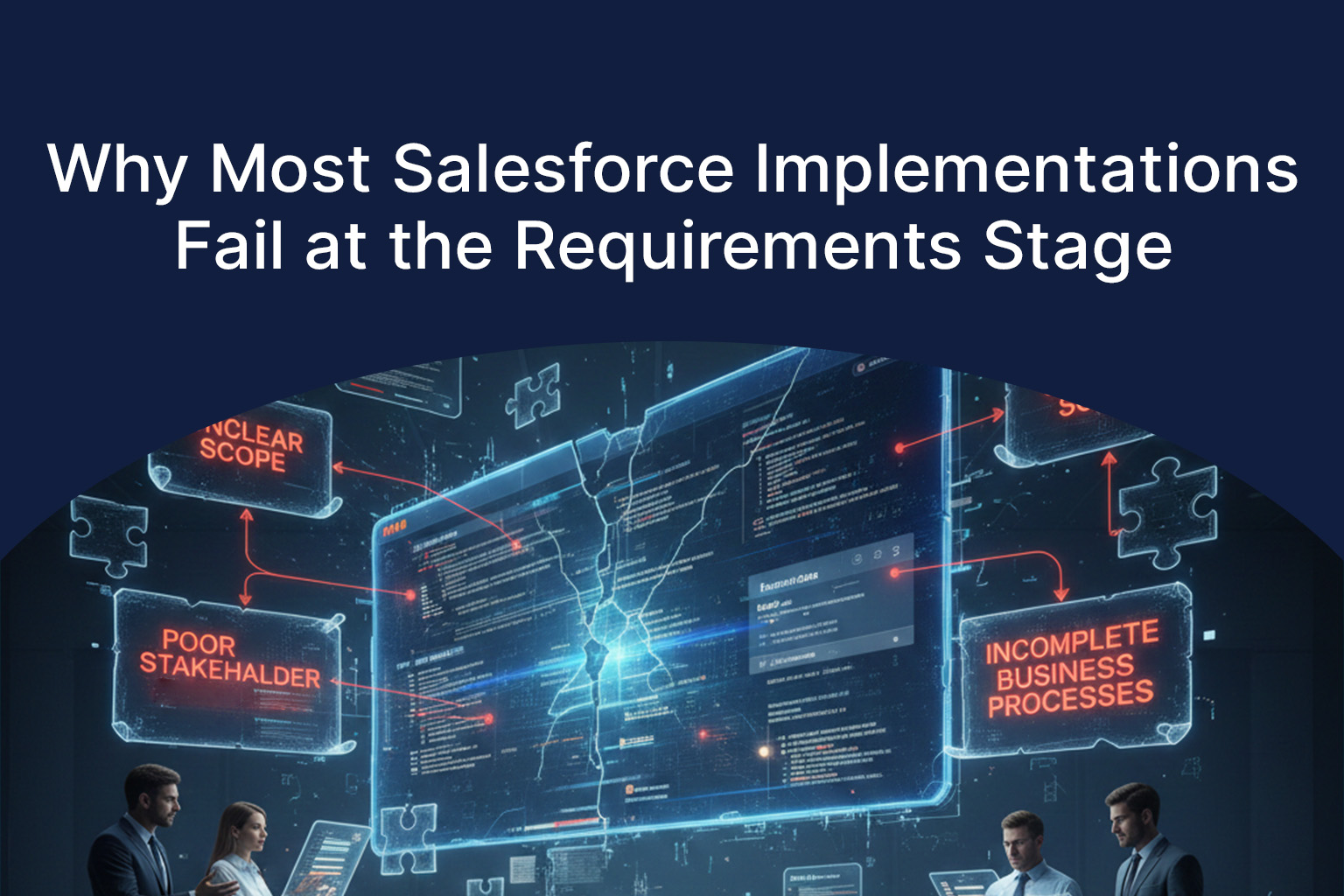
Salesforce implementations don’t usually fail because of poor technology or lack of investment. They fail because teams build solutions that don’t truly reflect how the business operates. Across industries, Salesforce implementation failures consistently trace back to one overlooked phase: requirements.
Even organizations that engage experienced teams and invest in Salesforce consulting services often underestimate the discipline required during requirements definition. When requirements are incomplete, misaligned, or rushed, Salesforce may still go live-but adoption drops, trust erodes, and value remains unrealized.
This article explains why Salesforce implementations fail, what goes wrong during Salesforce requirements gathering, and how organizations can avoid the most expensive mistakes before configuration begins.
Why the Requirements Stage Is the Most Critical Phase
The requirements stage shapes every technical and business decision that follows. It directly impacts:
- Data model structure
- Automation and workflow design
- Reporting and analytics accuracy
- Security and access controls
- User experience and adoption
Strong Salesforce requirements analysis creates alignment between business goals and system behavior. Weak analysis, on the other hand, locks assumptions into the platform-making them costly to undo later.
Most failures attributed to “poor adoption” or “bad design” are actually Salesforce implementation failures at the requirements stage.
Common Salesforce Implementation Failures Rooted in Requirements
1. Treating Stakeholder Opinions as Requirements
One of the most common Salesforce implementation mistakes is equating stakeholder opinions with business requirements.
Sales wants speed. Operations wants control. Leadership wants visibility. Without structured facilitation, requirements become a list of competing requests instead of a unified operating model.
Case-style insight:
A B2B services company allowed each sales manager to define deal stages independently. Salesforce was configured accordingly, but reporting became inconsistent and forecasting unreliable—forcing a partial reimplementation.
2. Documenting Current Processes Without Challenging Them
Many teams document existing workflows without questioning whether they should continue.
This approach leads to poor requirements gathering in Salesforce projects, where inefficiencies are replicated rather than resolved. Salesforce becomes a digital reflection of outdated processes instead of a system that improves them.
Effective requirements analysis focuses on outcomes, not habits.
3. Treating Requirements as a One-Time Exercise
Requirements are often gathered in early workshops and then “locked.” This creates blind spots.
In reality:
- Early sessions uncover surface needs
- Deeper insights emerge during data modeling
- Edge cases appear during scenario validation
Freezing requirements too early is a key reason why Salesforce implementations fail, particularly in fast-growing or complex organizations.
4. Ignoring Data and Reporting Requirements
UI screens and automation logic receive most of the attention, while data and reporting are addressed later-if at all.
Common oversights include:
- Undefined KPIs
- Inconsistent field usage
- Missing historical data needs
When reporting requirements surface late, they often conflict with earlier design decisions, leading to rework or compromised insights.
What Salesforce Implementation Failure Looks Like in Practice
Failure doesn’t always mean abandoning Salesforce. More often, it shows up as:
- Low user adoption despite training
- Manual work happening outside Salesforce
- Constant change requests after go-live
- Leadership mistrust in reports and dashboards
These symptoms almost always originate from a Salesforce implementation failure at the requirements stage, even if the impact is delayed.
Weak vs Strong Salesforce Requirements Analysis
| Weak Requirements | Strong Requirements |
|---|---|
| Feature-driven | Outcome-driven |
| Opinion-based | Evidence-based |
| Static documentation | Iterative validation |
| Limited user input | Cross-functional alignment |
| Minimal data planning | Reporting-first design |
Organizations that invest in strong Salesforce requirements analysis experience fewer change requests, faster adoption, and higher long-term ROI.
How to Prevent Requirements-Stage Failure
1. Start With Business Outcomes, Not Features
Requirements should answer why before what:
- Why automate this process?
- Why capture this data?
- Why change the current workflow?
Outcome-driven requirements reduce unnecessary customization and prevent future technical debt.
2. Validate Requirements Using Real Scenarios
Abstract use cases rarely expose complexity. Real scenarios do.
Examples include:
- A delayed approval
- A deal with multiple stakeholders
- A customer changing plans mid-cycle
Scenario-based validation reveals gaps that documentation alone often misses.
3. Use Early Prototypes and Visual Validation
Simple wireframes, sample records, or early demos allow stakeholders to see how decisions affect usability and reporting. This approach surfaces Salesforce implementation mistakes early-when fixes are still inexpensive.
Conclusion: Fix the Requirements to Fix the Outcome
Most Salesforce projects struggle not because of platform limitations, but because teams underestimate the importance of Salesforce requirements gathering.
Understanding why Salesforce implementations fail reveals a consistent pattern: weak requirements lead to strong downstream problems. When requirements are rushed, incomplete, or misaligned, Salesforce becomes harder to use, harder to trust, and harder to scale.
Organizations that work with the best Salesforce implementation partner treat requirements as a strategic investment-not a checkbox. Through structured discovery, collaborative analysis, and continuous validation, Salesforce becomes a platform that drives adoption, insight, and measurable business value.
Get the requirements right, and Salesforce delivers on its promise. Get them wrong, and even the best configuration won’t save the project.
 MCP Server