
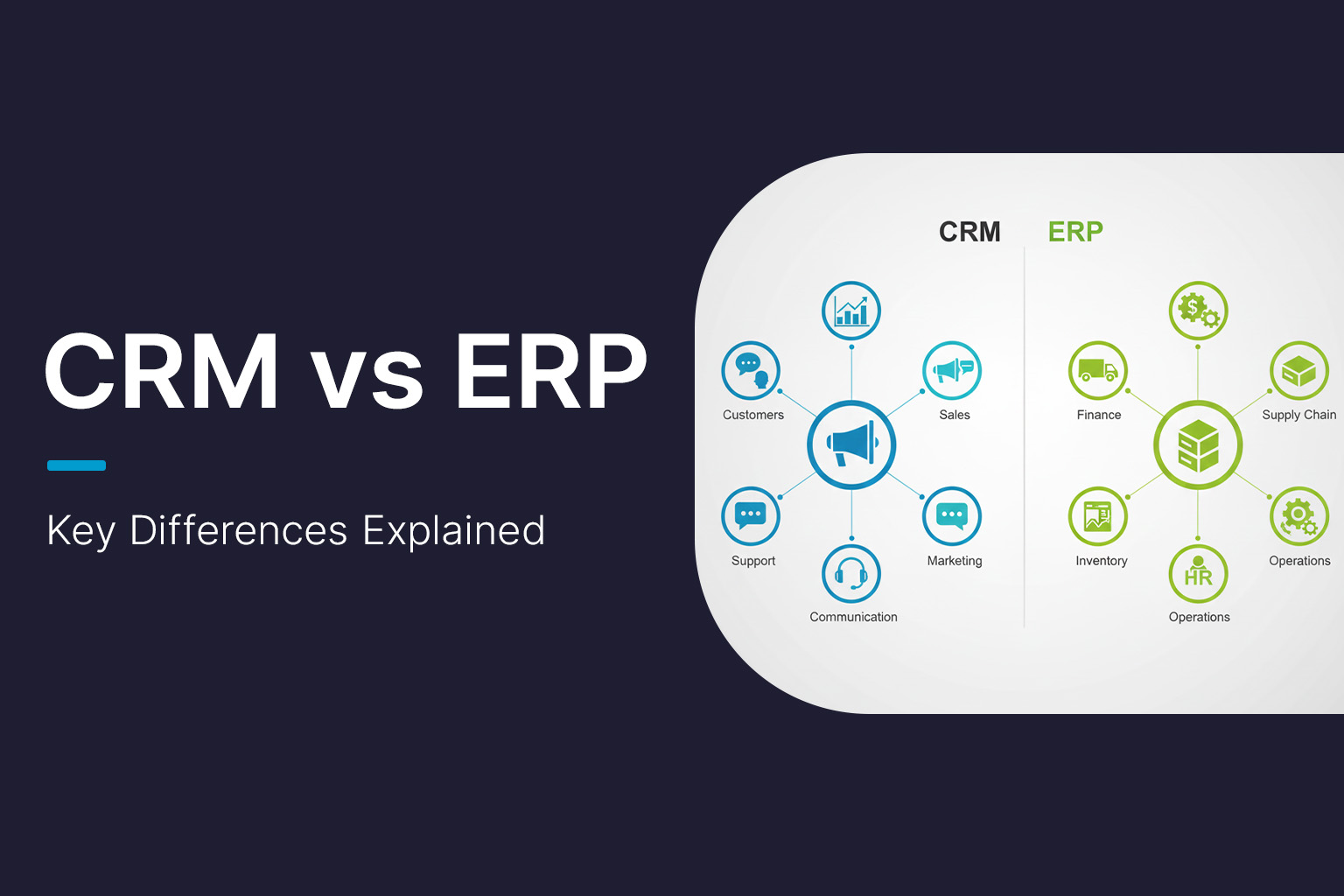
When businesses start scaling, spreadsheets and disconnected tools quickly become a liability. Sales teams want better visibility into customers, while operations teams need tighter control over finances, inventory, and workflows. This is where the debate around CRM vs ERP usually begins.
Although both systems are often discussed together, they solve very different problems. Understanding the difference between CRM and ERP helps decision-makers invest in the right software at the right time-and avoid costly implementation mistakes.
What Is CRM and Why Businesses Use It
Customer Relationship Management (CRM) software is designed to manage how a company interacts with prospects and customers across the entire lifecycle. From the first sales call to post-purchase support, CRM acts as a central system for customer data and engagement.
At its core, Customer Relationship Management (CRM) helps teams understand customer behavior, track sales opportunities, and improve communication. Sales and marketing teams rely heavily on CRM to manage pipelines, forecast revenue, and maintain consistent follow-ups.
A practical example is a B2B services firm using Salesforce to track leads from multiple channels. Every interaction-emails, calls, proposals, and follow-ups-is logged in one place, allowing sales managers to see which deals are moving forward and which need attention. This visibility directly impacts conversion rates and customer retention.
What Is ERP and How It Supports Operations
Enterprise Resource Planning (ERP) software focuses on internal business processes. While CRM looks outward toward customers, Enterprise Resource Planning (ERP) looks inward, connecting departments such as finance, inventory, procurement, HR, and production.
ERP systems centralize operational data so teams can work from a single source of truth. This reduces duplication, improves accuracy, and makes reporting far more reliable. Businesses with complex workflows-such as manufacturing, retail, or logistics-often depend on ERP to maintain efficiency as they grow.
For example, a retail company using ERP software can track inventory in real time, manage supplier payments, and generate accurate financial reports without relying on multiple disconnected tools. As transaction volume increases, ERP becomes essential for maintaining control and compliance.
CRM vs ERP: Core Differences That Matter
The CRM and ERP comparison becomes clearer when you look at their primary purpose rather than their features. CRM is designed to drive revenue through better customer relationships, while ERP ensures operational stability and scalability.
CRM systems are mainly used by sales, marketing, and customer support teams. ERP systems, on the other hand, are used by finance, operations, supply chain, and HR departments. One focuses on growth; the other focuses on efficiency.
This distinction is why many businesses struggle when trying to use one system to solve problems meant for the other. Choosing the right tool depends on whether the immediate challenge lies in customer engagement or internal operations.
CRM vs ERP: Key Differences at a Glance
Understanding ERP vs CRM becomes easier when you compare their core focus areas:
| Aspect | CRM | ERP |
| Primary Focus | Customers & sales | Internal operations |
| Main Users | Sales, marketing, support | Finance, operations, HR |
| Data Type | Leads, contacts, interactions | Inventory, finance, resources |
| Business Goal | Revenue growth | Operational efficiency |
| Typical ROI | Higher conversion & retention | Cost control & scalability |
This CRM and ERP comparison highlights why businesses often need both—but for different reasons.
Key Focus Areas of CRM
(Bullet points intentionally limited as requested)
- Lead management, sales pipelines, and customer communication
- Marketing campaign tracking and customer engagement analysis
- Support ticket management and post-sales service
Key Focus Areas of ERP
(Bullet points intentionally limited as requested)
- Financial management, accounting, and compliance
- Inventory, supply chain, and procurement processes
- Resource planning and internal workflow automation
ERP and CRM Integration: Why Businesses Combine Both
While CRM and ERP software serve different purposes, modern businesses increasingly rely on ERP and CRM integration to achieve full visibility. Integration ensures that customer data and operational data flow seamlessly between systems.
For instance, when a deal is closed in CRM, the ERP system can automatically generate an invoice, update inventory, and record revenue-without manual data entry. This reduces errors, speeds up fulfillment, and improves the customer experience.
Organizations that integrate both systems gain better forecasting capabilities, more accurate reporting, and smoother collaboration between departments. For growing companies, this integration often becomes a strategic advantage rather than a technical upgrade.
CRM vs ERP for Growing Organizations
Smaller businesses often begin with CRM to organize sales and customer data. As operations become more complex, ERP is introduced to manage finances, inventory, and resources. This phased approach allows teams to adopt systems gradually without disrupting daily operations.
However, fast-scaling companies sometimes benefit from implementing both systems together. In such cases, working with experienced partners offering CRM consulting services and Salesforce professional services helps ensure that CRM and ERP implementations are aligned from the start.
Choosing the Right Path: CRM, ERP, or Both
(Bullet points intentionally limited as requested)
- Choose CRM if improving sales performance and customer engagement is the priority
- Choose ERP if operational control, financial accuracy, and scalability are the main concerns
- Combine both when the business needs end-to-end visibility across customers and operations
Conclusion
The conversation around ERP vs CRM is not about selecting a “better” system-it’s about selecting the right system for your business goals. CRM strengthens customer relationships and revenue generation, while ERP builds the operational backbone that supports sustainable growth.
When implemented correctly, and especially when integrated, ERP and CRM software help businesses move faster, make better decisions, and scale with confidence. Whether you’re planning a CRM implementation, an ERP implementation, or both, success depends on clear objectives and the right expertise.
Investing in the right technology-supported by strong consulting and development partners-ensures that your systems grow with your business rather than holding it back.
 MCP Server