
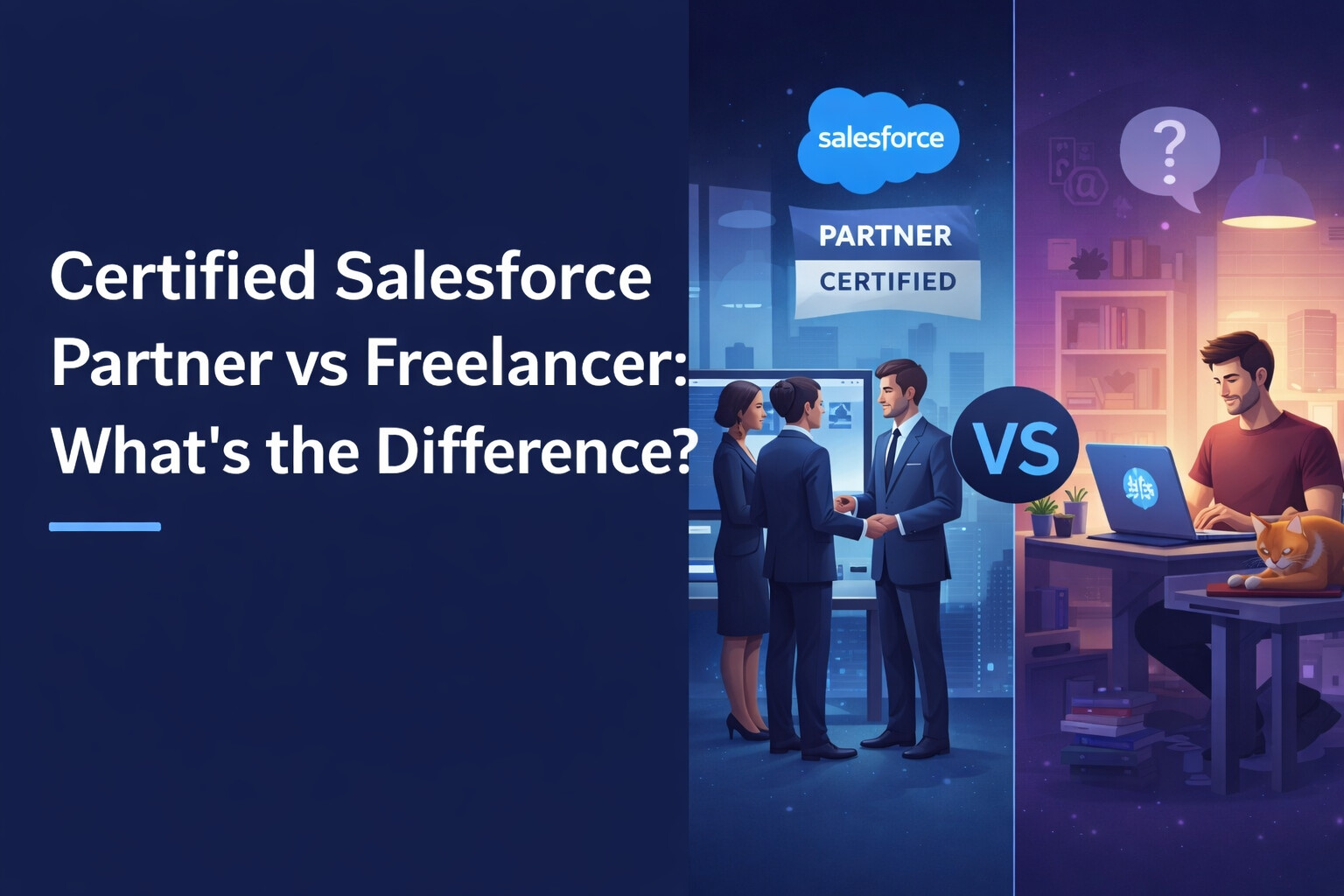
Choosing the right Salesforce expert can define the success or failure of your CRM investment. Whether you’re implementing Salesforce for the first time or scaling an existing setup, the decision often comes down to a certified Salesforce partner vs freelancer. On the surface, both may promise similar outcomes. In reality, the difference lies in accountability, depth of expertise, and long-term value.
Businesses exploring Salesforce Consulting Services frequently ask: Do we need a certified implementation partner, or will a freelancer be enough? The answer depends on more than budget. It depends on business complexity, growth plans, and risk tolerance.
This guide breaks down the difference between certified Salesforce partner and freelancer, with real-world comparisons to help you make an informed choice.
Understanding the Two Options
What Is a Certified Salesforce Partner?
A certified Salesforce partner is a consulting firm officially recognized by Salesforce. These partners meet strict requirements, including:
- Multiple Salesforce-certified professionals
- Proven project delivery track records
- Ongoing audits and performance reviews by Salesforce
- Access to partner-only tools, training, and support
Certified partners handle end-to-end Salesforce projects from strategy and implementation to optimization and managed services.
Also read – Top 10 Salesforce Consulting Companies in India
Who Is a Salesforce Freelancer?
A Salesforce freelancer is an independent consultant, usually specializing in specific Salesforce modules or tasks. Freelancers may be certified individually and often work on:
- Short-term projects
- Admin or configuration tasks
- Small business setups
- Ongoing support at an hourly rate
They typically operate solo, without organizational backing or formal quality controls.
Certified Salesforce Partner vs Freelancer: Core Differences
1. Scale and Team Strength
A key distinction in the Salesforce partner vs freelancer debate is capacity.
Certified partners bring structured teams solution architects, developers, QA specialists, and project managers. This ensures continuity even if one team member is unavailable.
Freelancers rely on individual availability. If they fall sick, take another project, or exit midway, your project can stall.
Example:
A mid-sized SaaS company migrating from HubSpot to Salesforce required parallel integrations, data cleansing, and automation. A freelancer struggled to meet timelines, while a certified partner deployed a cross-functional team to deliver within eight weeks.
2. Implementation Quality and Risk Management
When comparing Salesforce partner vs freelancer for implementation, governance matters.
Certified Salesforce partners follow defined frameworks like Salesforce’s Agile Accelerator or Sure Step methodologies. These frameworks reduce risks related to:
- Data migration errors
- Poor user adoption
- Security and compliance gaps
Freelancers often rely on personal experience rather than standardized processes, which can increase long-term technical debt.
3. Access to Salesforce Ecosystem
A lesser-known advantage of a certified Salesforce partner is direct access to Salesforce’s internal ecosystem.
Partners benefit from:
- Early product releases
- Priority support escalation
- Direct collaboration with Salesforce product teams
Freelancers do not have this access, which can slow issue resolution during critical phases.
4. Strategic Consulting vs Task Execution
The comparison between certified Salesforce partner vs Salesforce freelancer becomes clearer when strategy enters the picture.
Partners don’t just configure Salesforce they align it with business goals. This includes:
- Sales process redesign
- Marketing automation strategy
- Customer lifecycle mapping
- Analytics and forecasting models
Freelancers typically focus on execution rather than transformation.
Cost Comparison: Short-Term Savings vs Long-Term Value
At first glance, freelancers appear more affordable. Their hourly rates are usually lower, making them attractive for startups.
However, hidden costs often surface later:
- Rework due to poor architecture
- Performance issues as data grows
- Limited scalability
Certified partners may charge more upfront, but their work reduces long-term operational costs and reimplementation risks.
Insight:
Many enterprises that start with freelancers eventually engage a Salesforce implementation partner to fix foundational issues often doubling their original investment.
Compliance, Security, and Accountability
A major factor in the difference between certified Salesforce partner and freelancer is accountability.
Certified partners operate under legal contracts, SLAs, and compliance frameworks (GDPR, SOC 2, HIPAA where required). They also carry business insurance.
Freelancers may not provide formal guarantees, which can be risky for regulated industries like finance or healthcare.
When a Salesforce Freelancer Makes Sense
Freelancers are a good fit when:
- You need small configuration changes
- Budget is extremely limited
- The project scope is clearly defined
- Internal Salesforce admins can oversee the work
For example, adding custom fields, creating reports, or handling minor automation updates.
When to Choose a Certified Salesforce Partner
A Salesforce partner vs freelancer for implementation decision leans heavily toward partners when:
- Implementing Salesforce from scratch
- Migrating data from multiple systems
- Building complex automations or integrations
- Planning long-term CRM scalability
Certified partners bring stability, foresight, and structured delivery—essential for growing organizations.
Real-World Comparison Snapshot
| Criteria | Certified Salesforce Partner | Salesforce Freelancer |
| Team Support | Multi-skilled team | Single individual |
| Risk Management | Low | Medium to High |
| Scalability | High | Limited |
| Strategic Input | Strong | Minimal |
| Salesforce Access | Direct | None |
Final Thoughts: Making the Right Choice
The certified Salesforce partner vs freelancer debate isn’t about which option is better it’s about which is right for your business stage.
If you’re seeking tactical help, a Salesforce freelancer can deliver quick wins. But if your goal is long-term CRM success, data integrity, and scalable growth, working with a certified Salesforce partner offers unmatched value.
Organizations investing in top Salesforce Implementation services gain more than a configured system they gain a future-ready CRM aligned with business strategy. The right partner doesn’t just implement Salesforce; they help your business grow with it.
 MCP Server