
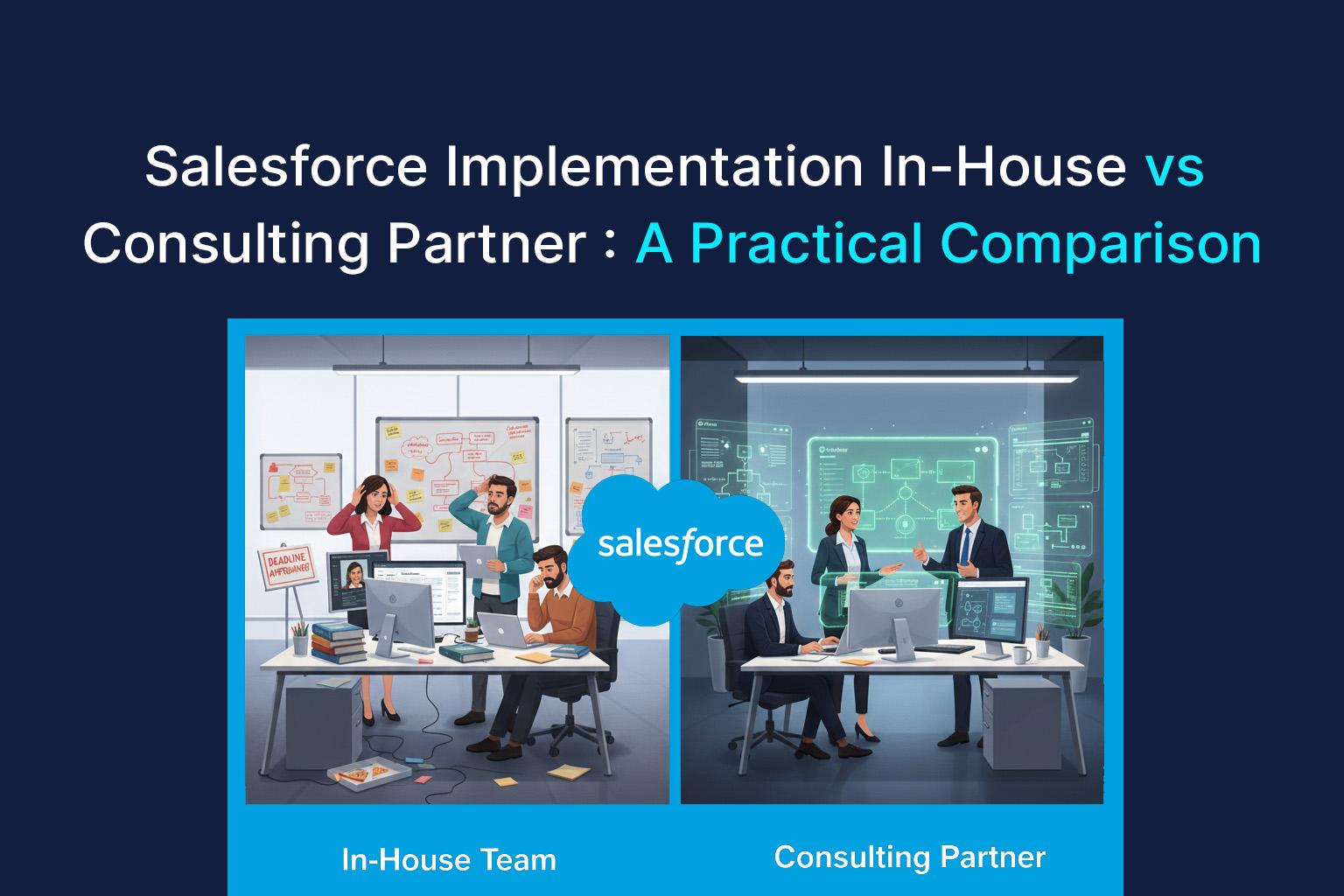
Choosing how to implement Salesforce is not a technical decision alone-it’s a strategic one. Whether you build internally or work with a consulting partner directly impacts cost, speed, scalability, and long-term ROI.
For many organizations, the real question isn’t whether Salesforce fits their business, but should Salesforce be implemented in-house or outsourced to a consulting partner who has done it dozens-or hundreds-of times before?
This blog breaks down the Salesforce implementation in-house vs consulting partner comparison with real-world insights, cost considerations, and decision frameworks to help you choose the right Salesforce implementation model for your organization.
Understanding the Two Salesforce Implementation Models
Before comparing outcomes, it’s important to define what each approach actually looks like in practice.
Salesforce Implementation In-House
An in-house Salesforce implementation relies on internal resources-admins, developers, business analysts, and IT leadership-to design, configure, customize, test, and deploy Salesforce.
This model is common among:
- Large enterprises with mature CRM teams
- Organizations with strong internal Salesforce expertise
- Companies seeking maximum control over customization
Salesforce Consulting Partner Model
A consulting partner brings external Salesforce-certified professionals to lead or co-own the implementation. This may include discovery, solution design, configuration, integration, data migration, testing, and post-go-live support.
This approach is often chosen by:
- Growing businesses without internal Salesforce specialists
- Enterprises with complex integrations or multi-cloud needs
- Teams seeking faster, lower-risk delivery
Most businesses today adopt a hybrid model, combining internal ownership with external execution.
Salesforce Implementation Comparison: Key Decision Factors
| Decision Factor | Salesforce Implementation In-House | Salesforce Consulting Partner |
|---|---|---|
| Upfront Cost | Appears lower initially but includes hidden costs like hiring, training, and trial-and-error | Higher upfront fees, but costs are predictable and structured |
| Total Cost of Ownership | Often increases over time due to rework, technical debt, and delayed delivery | Typically lower long-term cost due to fewer mistakes and faster execution |
| Time to Implement | Slower due to learning curves and competing internal priorities | Faster delivery using proven frameworks and accelerators |
| Expertise Level | Depends on internal team’s Salesforce experience | Access to certified architects, developers, and industry specialists |
| Scalability | Risk of poor early design limiting future growth | Designed with scalability and future expansion in mind |
| Customization Approach | Higher risk of over-customization | Strong focus on configuration-first best practices |
| Implementation Risk | Higher risk of design flaws, data issues, and adoption challenges | Lower risk due to experience across multiple implementations |
| Governance & Best Practices | Must be built internally from scratch | Established governance , security , and architecture |
| Flexibility & Control | Full internal control over decisions and timelines | Shared control with structured delivery models |
| Post-Go-Live Support | Ongoing burden on internal resources | Optional managed support and optimization services |
| Best Fit For | Organizations with mature Salesforce teams and simple requirements | Businesses needing speed, reliability, and Affordable Salesforce implementation services |
When Salesforce Implementation In-House Makes Sense
Despite the advantages of consulting partners, in-house implementation is not wrong in every scenario.
Choose in-house if:
- You already have experienced Salesforce architects and developers
- The implementation scope is small or incremental
- Customization needs are minimal
- You have time to learn and iterate
For example, a SaaS company with an internal RevOps team may handle Sales Cloud enhancements internally while outsourcing complex integrations.
When to Choose a Salesforce Consulting Partner
Knowing when to choose a Salesforce consulting partner can prevent costly rework.
A consulting partner is the better choice when:
- You’re implementing Salesforce for the first time
- Multiple clouds or integrations are involved
- Data migration is complex
- Compliance or industry regulations apply
- You need predictable timelines and outcomes
A real-world example:
A mid-sized manufacturing firm attempted an in-house Salesforce rollout but struggled with ERP integration and reporting. After engaging a consulting partner, the project was restructured, delivered in phases, and adoption improved within three months.
How to Decide Between In-House and Salesforce Partner
If you’re still evaluating how to decide between in-house and Salesforce partner, ask these questions:
- Do we have proven Salesforce implementation experience internally?
- Can we afford delays or rework?
- Is scalability a short-term or long-term goal?
- What is the true cost of internal time and learning?
- Would a hybrid model reduce risk?
Often, the smartest decision is not binary. Many successful teams use partners for architecture and initial rollout, then transition ownership internally.
A Balanced Salesforce Implementation Model
The most effective Salesforce implementations today follow a blended model:
- Consultants handle strategy, architecture, and complex builds
- Internal teams manage ongoing enhancements and adoption
This approach delivers speed, quality, and cost control-without long-term dependency.
When aligned with the right consulting approach, businesses achieve Affordable Salesforce implementation services while retaining internal ownership.
Conclusion: Choose Value Over Assumptions
The debate around Salesforce implementation in-house vs consulting partner isn’t about which model is better—it’s about which approach is right for your business at this stage.
In-house implementation offers control, but it demands deep expertise, time, and ongoing commitment. Consulting partners, on the other hand, bring speed, experience, and reduced delivery risk—provided the engagement model is aligned with your goals and scope.
Organizations that succeed don’t ask, “How do we spend less?”
They ask, “How do we avoid costly mistakes?”
By selecting the right Salesforce implementation model-and working with Reliable Salesforce Implementation Services backed by a strong Salesforce consulting strategy-you position your CRM for long-term scalability, user adoption, and measurable business impact, rather than short-term survival.
Also Read – Salesforce Implementation Guide
 MCP Server